Abstract:
This experiment was conducted to investigate the effect of a commercial toxin binder (Bentomax Plus) in reducing the adverse effects of aflatoxin B1 on growth and performance of broiler chickens. In this study, 320 Ross 308 broiler chickens were used in a completely randomized design with 5 treatments, 4 replications and 16 chickens for each replication. The experimental treatments were: 1) Negative control (diet without aflatoxin and Bentomax Plus) 2) Positive control (containing aflatoxin) 3) Positive control + 0.5 kg/ton Bentomax Plus 4) Positive control + 1 kg/ton Bentomax Plus 5) Positive control + 2 kg/ton Bentomax Plus. Feed consumption and weight gain in the positive control group were reduced compared to the other groups (p<0.05). Feed conversion ratio in the negative control group and the groups containing Bentomax Plus was significantly lower than in the positive control group (p<0.05). Carcass yield in the positive control group was significantly lower than in the other groups (p<0.05). Relative liver weight in the positive control group increased compared to the other groups (p<0.05), but the relative weight of the heart, gizzard, spleen, forestomach and abdominal fat was not affected (p>0.05). Relative bursa of Fabricius weight in the positive control group was significantly lower than in the other groups (p<0.05). The results showed that the addition of a multicomponent toxin binder (Bentomax Plus) can reduce the negative effects of aflatoxin on the growth and performance of broilers.
Introduction:
Mycotoxins are a group of secondary metabolites of fungi that are widely found in animal and human food and cause significant economic losses in animal husbandry worldwide (Dresjant et al., 2003). Among the hundreds of known types of mycotoxins, a few of them are relevant in the poultry industry, including aflatoxins, ochratoxins, trichothecenes, zearalenones and citrinins. Aflatoxins are a group of common toxins in food that are produced by the fungi Aspergillus flavus and Aspergillus parasiticus.
Aflatoxins include types B1, B2, G1 and G2, of which type B1 is the most toxic and carcinogenic of all. Aflatoxin contamination of food is a major global issue, and estimates indicate that at least 25% of the world’s grain production is contaminated with mycotoxins (Binder et al., 2007). Since the isolation and identification of aflatoxins, these compounds have gained a special place in human and animal health due to their various biological effects (including carcinogenicity, mutagenicity, teratogenicity, hepatotoxicity, nephrotoxicity, skin toxicity, and immunosuppressive effects) and biochemical effects (including effects on carbohydrate and lipid metabolism, protein and nucleic acid synthesis) (Daghir et al., 1995).
The disease caused by aflatoxins is called aflatoxicosis. Aflatoxicosis causes detrimental effects on all important production indices, including weight gain, feed intake, and feed efficiency, in both male and female pigs. Aflatoxicosis in broilers mainly occurs in a chronic form and its most important symptoms include growth retardation, loss of body weight and feed intake, reduced feed efficiency, pale color, paralysis and lameness (Kobena et al., 1998). The most important changes caused by aflatoxicosis occur on the carcass, in the liver and then in the kidneys and lymphatic tissues (Kobena et al., 1998). In general, aflatoxicosis causes changes in some blood and serum biochemical indices of birds. Reported changes in blood indices include a decrease in hematocrit, hemoglobin, red blood cell count and percentage of lymphocytes and an increase in total white blood cell count and percentage of heterophils (Ogaz et al., 2000; Raju and Devagoda, 2000).
Various nutritional strategies including physical, chemical and biological methods have been proposed to remove or inactivate aflatoxins, but the most effective nutritional method to prevent mycotoxin poisoning is the use of adsorbent compounds (Wang et al., 2006). The most important of these materials include bentonites, zeolites, aluminosilicates and glucomannans derived from yeasts, which are commercially available (Kisses et al., 1998). The extent of toxin binding to the above compounds varies considerably. Some of these materials, such as clays, bind only to aflatoxins and leave other toxins unchanged in the digestive tract, but some of these materials, such as yeast cell walls or esterified glucomannan, are effective against a wide range of mycotoxins (Aravind et al., 2003).
Bentomax Plus is an organic-mineral combination that combines the best aluminum silicate adsorbents, yeast and bacterial cell walls with very large adsorption surfaces and a large number of diverse adsorption sites. Modifications have been made to the structure of glucomannan so that its capacity and affinity have been increased. Research on yeast cell walls has proven that these organic compounds are effective in reducing the individual and combined effects of aflatoxin, ochratoxin A and T2 toxin in broilers and significantly increase body weight and serum antibody titer (Raju and Devagoda, 2000). Therefore, this study was conducted to investigate the effects of Bentomax Plus on reducing the negative effects of aflatoxins on the performance of Ross strain broilers.
Materials and Methods:
Preparation of Experimental Diets
Control diets for the starter (0-21) and grower (22-42) periods were prepared and adjusted based on the NRC (1995) nutritional requirements for broilers. The aflatoxin level in the control diet was below the detectable limit (less than one microgram per kilogram of diet). Moldy corn kernels were obtained from local feed mills and stored at 20% relative humidity for two months to enhance mold growth and then dried completely to inhibit mold growth. Diets containing moldy or aflatoxin were prepared by replacing mold-infected corn with healthy corn. High-performance liquid chromatography was used to measure aflatoxin concentrations according to the AOAC (2000) guidelines.
The final analysis of the mold-contaminated diets indicated the presence of 254 ppb of aflatoxins, of which 78.6% was aflatoxin B1, 8% aflatoxin B2, 11% aflatoxin G1, and 2.4% aflatoxin G2. During the experimental period, the control and contaminated diets were analyzed for aflatoxin levels, and the levels of aflatoxins in the control diet were below the detectable limit (less than 10 micrograms per kilogram) and in the contaminated diets were around 285-278 ppb.
Experimental design, chicks, and data collection
A total of 320 Ross 308 broiler chickens were reared on the litter in a completely randomized design with 5 treatments, 4 replications, and 16 chicks per experimental unit for 42 days. The experimental treatments were: 1) Negative control (diet without aflatoxin and Bentomax Plus) 2) Positive control (containing aflatoxin) 3) Positive control + 0.5 kg/ton Bentomax Plus 4) Positive control + 1 kg/ton Bentomax Plus 5) Positive control + 2 kg/ton Bentomax Plus.
On day 42 of the experimental period, two chickens from each replicate with a weight close to the average were selected and slaughtered by cutting the jugular vein. To determine the characteristics related to carcass characteristics such as carcass weight, abdominal fat, liver and gizzard, heart, spleen and bursa of Fabricius, the carcasses were separated using a standard method and weighed using a digital scale with an accuracy of ± 0.01 g and expressed as a percentage of the bird’s live weight. The data obtained were analyzed in a completely randomized design. The GLM procedure of SAS statistical software version 9.1 (2001) was used to analyze the data. Duncan’s multiple range test was used to compare the means at a significance level of 0.5.
The statistical model of this design is as follows:
Yij = µ + Ti + eij
Yij = value of each observation in treatment i in replication j, µ = population mean for the trait of interest, Ti = effect of treatment i, eij = residual effects (experimental error).
Results and Discussion
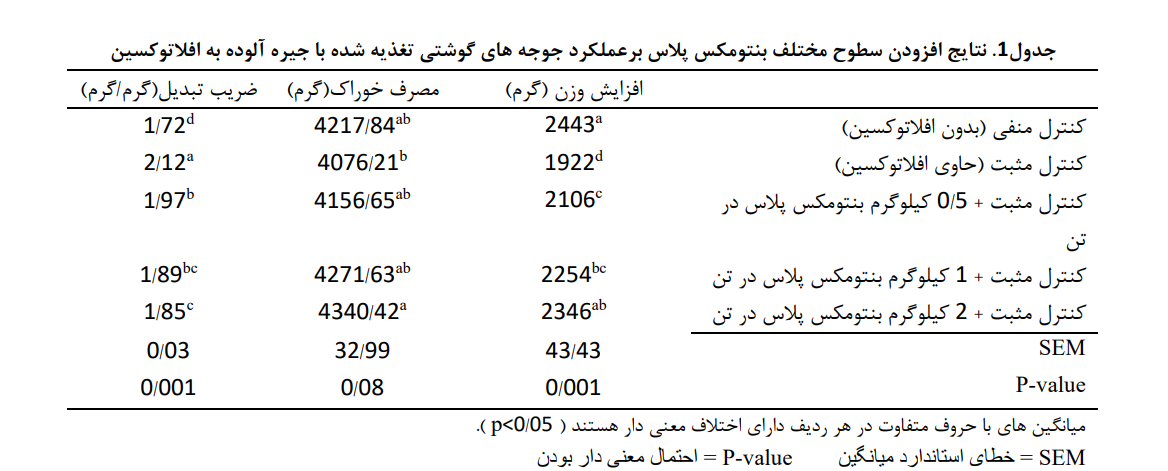
The results of feed intake, body weight gain and feed conversion ratio in broilers fed aflatoxin-contaminated diet and different levels of Bentomax Plus addition are given in Table 1. Body weight gain and feed consumption were affected by aflatoxin during the rearing period, with the positive control group having the lowest weight gain and feed consumption compared to the negative control group (p<0.05), but the receiving groups had better weight gain and feed consumption compared to the positive control group, and the treatment receiving 2 kg/ton Bentomax Plus did not differ significantly from the negative control group. In terms of feed conversion ratio throughout the rearing period, the negative control group was significantly lower than the other groups (p<0.05). The feed conversion ratio in the groups that received aflatoxin along with Bentomax Plus was significantly higher than the positive control group (p<0.05). Common signs of aflatoxinosis in poultry and domestic animals are reduced growth rate and poor performance. Failure to gain body weight in poultry flocks leads to economic losses and severe aflatoxin-related diseases (Basmakioglu et al., 2005). The adverse effects of aflatoxins on feed intake, body weight gain, and feed conversion ratio are likely to be the result of anorexia, apathy, and inhibition of protein synthesis and lipogenesis (Oguz et al., 2000). Damage to hepatic reactions and mechanisms of protein and fat utilization may affect performance, growth, and overall health (Otatatli et al., 2005). The results of the effects of aflatoxin and adsorbents on performance and growth in this experiment are consistent with previous reports (Raju et al., 2000). The effective factor of adsorbents is their rapid incorporation into mycotoxins in a short period of time. Absorbents added to aflatoxin-contaminated diets absorb this toxin, preventing its absorption in the animal’s digestive tract and excrete the toxin with it (Lee et al., 2010). In the present experiment, the addition of all three levels of the toxin binder Bentomax Plus improved growth and performance indicators, but statistically, the group that received aflatoxin B1-contaminated feed along with 2 kg/ton of Bentomax Plus was closer to the negative control group.
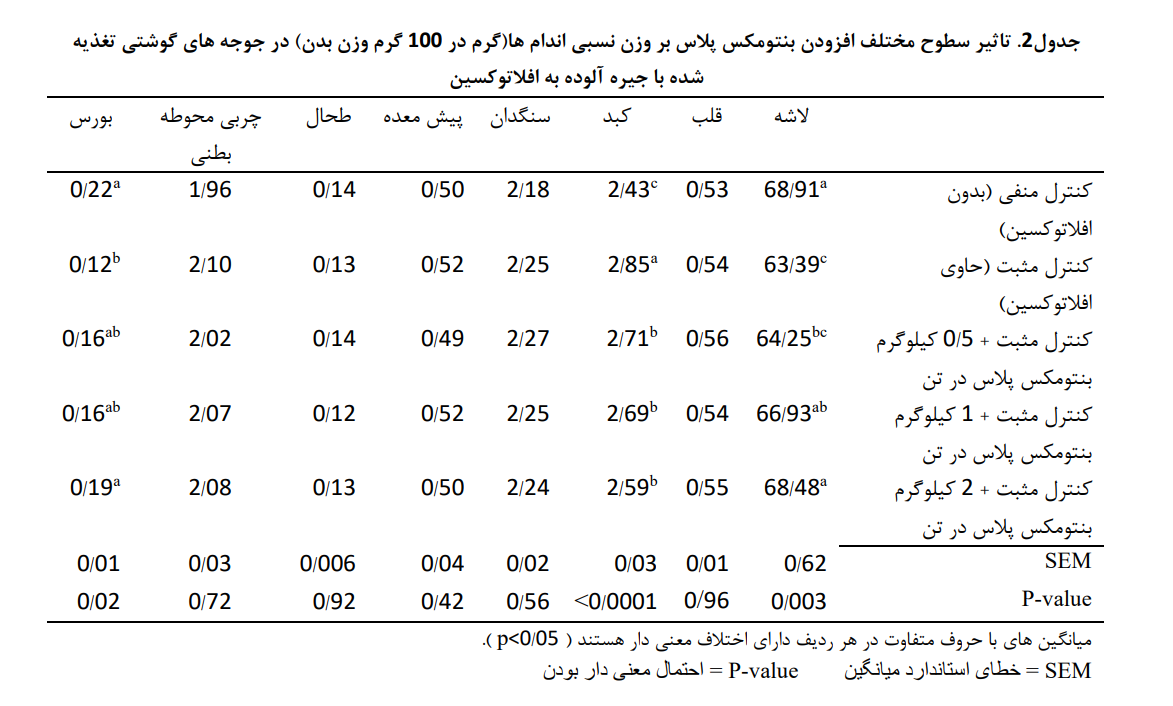
The results of the effects of different treatments on the relative weight of internal organs are shown in Table 2. The carcass yield in the positive control group was the lowest compared to the negative control (p<0.05) and there was no significant difference between the two levels of 1 and 2 kg of Bentomax Plus with the negative control group. There was no significant difference in the relative weight of the heart, gizzard, forestomach and spleen between the groups. There was no significant difference in the relative weight of the abdominal fat between the treatments, but it was higher in the positive control group compared to the other group. It seems that the liver is the first organ to be affected by aflatoxin poisoning (Miyazu et al., 2005). An increase in the relative weight of the liver as a result of aflatoxin consumption has also been reported by Kubena et al. (1998) and Hoff et al. (1986). The liver of chickens fed a diet containing aflatoxin compared to the liver of chickens fed a healthy diet; It was larger, yellower, fatter and more fragile. One of the reasons for the increase in relative liver weight in chickens fed aflatoxin-containing diets is the increase in fat deposition, which is caused by a disorder in fat metabolism (Daghir et al., 1995). The relative weight of the bursa of Fabricius in the positive control group was significantly reduced compared to the other groups (p<0.05). Hoff et al. (1986) studied the effect of different levels of aflatoxin on the organs of the liver, forestomach, gizzard, spleen and kidneys. Among these organs, the liver was more sensitive than other organs to all levels of aflatoxin, and with increasing aflatoxin in the diet, the relative weight of the liver also increased (Hoff et al., 1984). It has been reported that feeding 0.5-0.25 ppm of aflatoxin in the diet of broiler chickens had a significant effect on the relative weight of the liver and bursa of Fabricius, but had no effect on the relative weight of the spleen and thymus (Bartoff et al., 1985). The use of mycotoxin adsorbents in this study reduced the effect of aflatoxin on the relative weight of the liver and bursa of Fabricius, so that no significant difference was observed between the treatments containing mycotoxin adsorbents and the healthy control treatment. However, the effect of aflatoxin on the organs was not completely eliminated by the use of mycotoxin adsorbents, which again indicates the sensitivity of these two organs to aflatoxin. It has been reported that the addition of 0.3% sodium bentonite to a diet containing 0.2 ppm aflatoxin B1 reduced the relative weight of the liver, kidneys, and spleen in Ross strain broilers (Miyazo et al., 2005). An increase in the relative weight of liver and gizzard in chickens fed aflatoxin-containing diets that were naturally contaminated and contained 168 ppb of aflatoxin, as in the present study, has been reported, and the effect of aflatoxin on the increase in the relative weight of liver and gizzard in the aforementioned study was eliminated by using yeast cell walls (Aravind et al., 2003). It is concluded that aflatoxin present in the diet of broiler chickens has adverse effects on the performance and weight of their internal organs compared to aflatoxin-free diet. The use of mineral and organic toxin adsorbents and yeast cell walls in the diet improves their performance by reducing the adverse effects of aflatoxin on the internal organs and function of chickens.